Guía profesional: Cómo montar una torre de andamio de aluminio de forma segura y eficiente.
Mar 26, 2026En los sectores modernos de la construcción, la ingeniería y el mantenimiento, el trabajo en altura sigue siendo la principal causa de muertes y lesiones graves en el lugar de trabajo. Torre de andamios de aluminioSe ha consolidado como una solución de primera categoría para estos desafíos, ofreciendo una combinación única de alta relación resistencia-peso, despliegue rápido y resistencia a la corrosión.
Sin embargo, la comodidad de las torres de acceso móviles suele generar complacencia. Una torre no es simplemente una escalera con una plataforma; es una estructura de ingeniería de precisión que se basa en la lógica de las celosías y en componentes interconectados. Un desconocimiento de la física de una torre, como su centro de gravedad o su resistencia a la carga del viento, puede provocar fallos estructurales catastróficos.
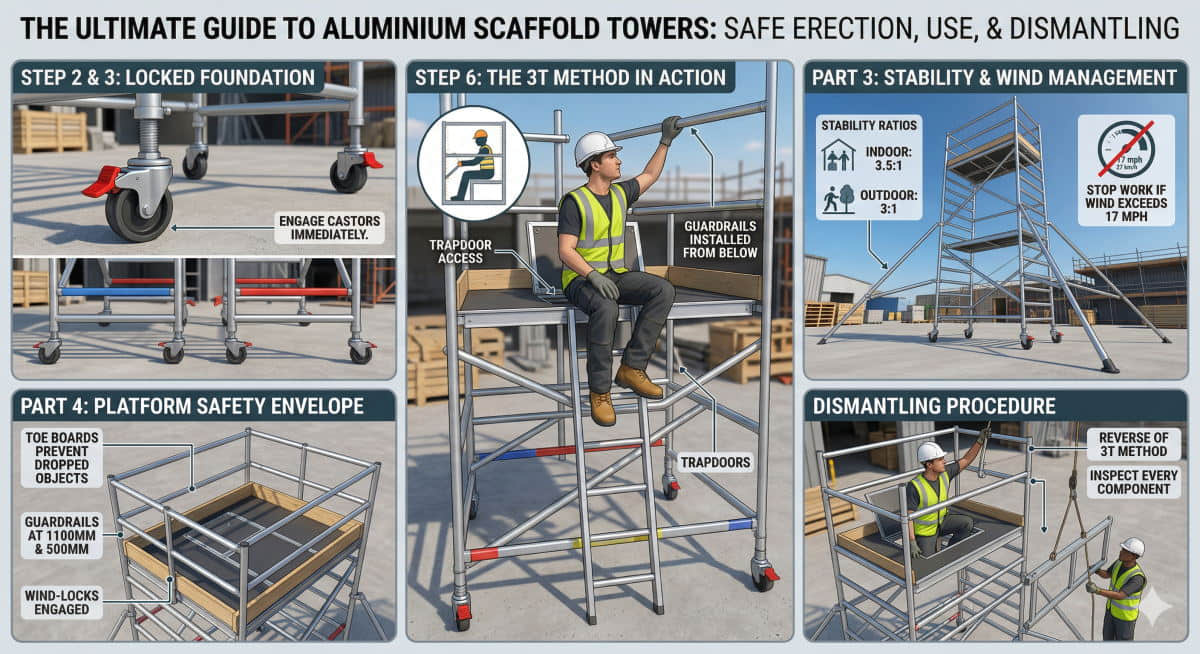
Antes de que cualquier equipo salga del almacén, debe llevarse a cabo una rigurosa fase de premontaje. En entornos profesionales, esto implica mucho más que una simple mirada al suelo.
La mayoría de las torres de aluminio de alta calidad están diseñadas para cumplir con la norma EN 1004. Esta norma especifica los materiales, las dimensiones y las cargas que la torre puede soportar de forma segura. Como profesional, debe verificar que su torre tenga la clasificación de carga específica requerida para su tarea. Generalmente, se requiere una clasificación de Clase 3 para trabajos de construcción en general, que soporta una carga distribuida de 2,0 kN/m².
Se debe realizar una evaluación de riesgos y una declaración de métodos formales (RAMS). Las consideraciones clave incluyen:
Cada componente debe verificarse según las especificaciones del fabricante. Utilizar componentes de diferentes marcas de forma indiscriminada constituye una grave infracción de seguridad que puede provocar un colapso estructural.
Seguir una secuencia estandarizada reduce el margen de error humano. Utilizamos el método 3T, que es el estándar de referencia para la protección colectiva contra caídas en la Unión Europea y el Reino Unido.
Despeje un perímetro de al menos 2 metros alrededor del área de trabajo prevista. Coloque todos los componentes de forma sistemática: marcos, soportes, plataformas y estabilizadores. Esto evita tener que buscar piezas en altura, lo cual es una de las principales causas de sobreestiramiento, factor clave en las caídas desde altura.
Comience con dos marcos base (generalmente marcos de escalera). Inserte las patas ajustables y las unidades de ruedas.
Une los dos marcos usando dos soportes horizontales.
Utilice un nivel de burbuja profesional tanto en los marcos como en los tirantes horizontales.
Instale una plataforma con trampilla en el nivel más bajo recomendado.
A medida que se añaden los fotogramas subsiguientes (normalmente secciones de 2 metros), el método 3T dicta una posición específica al sentarse:
Acceda a la plataforma a través de la trampilla.
A la altura final de funcionamiento, la torre debe estar completamente cerrada.
Comprender la física de una torre móvil es lo que distingue a un profesional de un aficionado. Las torres de aluminio son ligeras por diseño, lo que las hace vulnerables a la fuerza del viento.
El "Índice de Estabilidad" es la altura de la torre dividida por la dimensión mínima de su base.
Uso interno: Normalmente, una relación de 3,5:1 es aceptable si no hay cargas laterales.
Uso externo: Debido a las cargas de viento, esta relación se reduce a 3:1. Si su torre tiene 2 m de ancho y 1 m de profundidad, su "dimensión de base" para el cálculo es de 1 m, lo que significa que su límite de altura es significativamente menor que el de una torre de base cuadrada.
Con vientos superiores a 27 km/h (17 mph), se debe detener todo trabajo en la torre. A velocidades mayores, la torre debe desmontarse o sujetarse firmemente a una estructura permanente mediante anclajes especiales. Nunca coloque redes de protección ni pancartas grandes en una torre móvil; estas crean un efecto de vela que puede generar la fuerza suficiente para volcar incluso una torre completamente estabilizada con ráfagas moderadas.
El desmontaje no es simplemente "montar a la inversa"; requiere un cuidado específico para garantizar que ningún componente se caiga o se dañe.
Despeje la plataforma: Asegúrese de que no queden herramientas, escombros ni rodapiés en el nivel superior.
El descenso 3T: Acceda a la plataforma superior mediante la escalera interior. Abra la trampilla y siéntese dentro.
Retire las barandillas: Desde la posición sentada, desenganche los soportes de la barandilla. Deje siempre los soportes inferiores en su lugar hasta que haya descendido al siguiente nivel.
Manipulación de componentes: Pase los componentes a un compañero o utilice un cable de elevación fiable y un sistema de poleas ligero. Nunca arroje los componentes al suelo. El impacto contra el hormigón provoca microfisuras en el aluminio, invisibles a simple vista, que pueden causar fallos catastróficos durante el siguiente uso.
Para las empresas de alquiler de equipos y los grandes contratistas, la vida útil de la torre depende de un mantenimiento profesional.
NuncaUtilice una torre como soporte para una escalera u otro andamio.
NuncaMover una torre cuando haya personas o materiales sobre ella.
NuncaSube por el exterior de la torre.
Nuncautilizar una torre a la que le falte su "Scafftag" o registro de inspección.
NuncaNo se incline sobre las barandillas para realizar el trabajo; en su lugar, mueva la torre.
NuncaSúbete a las barandillas para ganar altura.
Dominar el montaje de una torre de andamios de aluminio es una competencia fundamental para cualquier empresa moderna de construcción o ingeniería. Al adherirse a las normas Proceso de 7 pasosy el Método 3TNo solo estás siguiendo las reglas, sino que también estás protegiendo vidas, reduciendo el riesgo del proyecto y aumentando la eficiencia del equipo.
En un sector donde la reputación se basa en la seguridad y la fiabilidad, utilizar equipos de alta calidad que cumplan con la norma EN 1004 es el primer paso. El segundo es garantizar que su equipo esté capacitado, sea competente y diligente en sus prácticas de montaje. Un lugar de trabajo seguro es un lugar de trabajo productivo, y una torre bien montada es la piedra angular de esa seguridad.
Correo electrónico : aj-steven@dghualifeng.com.cn


Friendly Links :
Kitchen Cabinet© 2026 Material de construcción Co., Ltd de Guangzhou AJ Reservados todos los derechos

 en
en fr
fr es
es