Andamios En la construcción de edificios de gran altura y el mantenimiento de infraestructuras, la estabilidad de las estructuras depende directamente de sus cimientos. Si bien los profesionales de la seguridad suelen centrarse en las barandillas, los tablones y los apuntalamientos de los niveles superiores de un andamio, la base suele ser el punto débil. Un pequeño desplazamiento inicial en la base del andamio puede traducirse en una inclinación significativa en la parte superior, lo que podría provocar fallos catastróficos y estructuras inestables en la obra.
Intuitivamente, la necesidad de un soporte para andamios parece obvia; sin embargo, no se basa en el sentido común, sino en el estricto cumplimiento de los principios de diseño de ingeniería. Esta ficha informativa aborda algunos de los materiales inadecuados más comunes que se utilizan para intentar soportar un andamio y examina sus propiedades físicas y las razones de su inadecuación.
La física del soporte de andamios
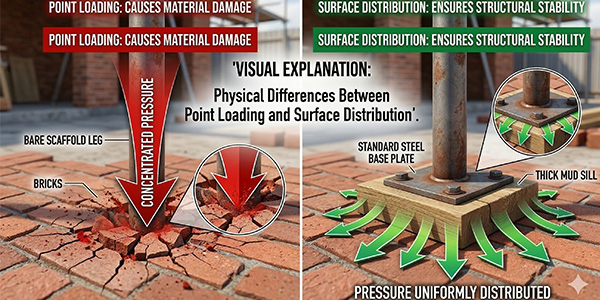
La razón por la que ciertos materiales están prohibidos en un andamio está directamente relacionada con la distribución de la carga. Como todos sabemos, un andamio completamente cargado es un objeto muy pesado, y debemos recordar cómo se transmite ese peso a través del sistema. Un andamio completamente cargado ejerce una enorme cantidad de peso directamente sobre el suelo a través de sus elementos verticales. Este es un ejemplo de carga puntual.
Una carga puntual generada por una pata de andamio apoyada sobre una superficie blanda es motivo de gran preocupación. Esto se debe a que la presión es igual a la fuerza dividida por el área. Por lo tanto, una carga puntual es una fuerza concentrada. Si la superficie de apoyo es blanda o débil, esta fuerza puede ser insuficiente para hacer algo más que penetrar la superficie o, posiblemente, aplastar cualquier material que encuentre en su camino hacia el suelo firme. En cualquier caso, esto no es ideal para la estabilidad del andamio. En un buen andamio, la carga puntual generada por una pata de andamio al apoyarse sobre terreno blando se eliminaría, o se reduciría al mínimo, mediante un separador, para distribuir la carga sobre un área más amplia y así asegurar que el suelo pueda soportarla.
El material del soporte debe ser capaz de soportar la fricción generada, sin ceder, romperse ni deslizarse.
La lista de los prohibidos
El error más común que observamos es cuando un contratista utiliza materiales de la obra para nivelar su andamio. Los siguientes elementos no están diseñados para la construcción pesada.
1. Ladrillos, bloques de hormigón y unidades de mampostería
- Fragilidad y agrietamiento:Los ladrillos y bloques de hormigón están diseñados para soportar peso cuando forman parte de un sistema de muro completo, donde las cargas se distribuyen uniformemente. Sin embargo, cuando se utilizan como soporte independiente para una pata de andamio, están sujetos a una carga puntual. Esta presión concentrada puede provocar que el ladrillo se agriete o se rompa instantáneamente sin previo aviso.
- Inestabilidad del apilamiento:Apilar varios ladrillos crea múltiples puntos débiles. Si un ladrillo de la pila se desplaza o se rompe, toda la pata se desploma, provocando un cambio repentino y violento en el centro de gravedad del andamio.
- Fallo del núcleo hueco: Los bloques de hormigón suelen ser huecos. Colocar una placa metálica de alta resistencia sobre un núcleo hueco puede provocar que las delgadas paredes de hormigón del bloque se derrumben hacia adentro.
2. Cubos de cinco galones y recipientes de plástico
Utilizar un cubo de plástico o un bidón de metal como calza o extensor de altura es un acto de pereza tremendamente ignorante que demuestra un desprecio total por los principios de la ciencia de los materiales.
- Degradación del material:La mayoría de los cubos industriales están fabricados con polietileno de alta densidad (HDPE). Si bien son resistentes para transportar líquidos, no están estabilizados contra los rayos UV para soportar cargas estructurales a largo plazo y pueden volverse quebradizos con la exposición al sol.
- Colapso por compresión:Un cubo no tiene refuerzos internos. Bajo el peso de un andamio, las paredes del contenedor se deformarán o se "acordeón", lo que provocará el colapso total de ese punto de apoyo.
- Falta de fricción: Los contenedores de plástico y metal tienen bajos coeficientes de fricción. Sobre una superficie de hormigón o pavimentada, estos soportes pueden deslizarse fácilmente si el andamio está sometido a cargas de viento o movimientos laterales provocados por el personal.
3. Madera de desecho y paletas de envío
Si bien la madera es un componente estándar en los andamios (en forma de largueros de barro), la madera de desecho es inherentemente poco fiable.
- Defectos internos:La madera de desecho suele contener nudos, grietas o podredumbre que no son visibles a simple vista. Bajo carga, estos defectos se convierten en puntos de concentración de tensión donde la madera se partirá.
- Vulnerabilidad de los palés:Los palés de envío están diseñados para cargas distribuidas (como una caja colocada encima), no para el peso concentrado de una pata de andamio. La placa base de un andamio puede perforar fácilmente las finas lamas de un palé, provocando que el andamio caiga varios centímetros al instante.
- Compresión de madera blanda: Muchos de los trozos de madera de desecho están hechos de madera blanda de baja calidad que puede comprimirse significativamente al mojarse, lo que da como resultado una plataforma desnivelada e inestable.
4. Suelo congelado y terreno sin preparar
En ocasiones, el "material" que provoca la falla es el propio terreno.
- El peligro del deshielo:En climas fríos, el suelo congelado por la mañana puede sentirse como hormigón. Sin embargo, a medida que la temperatura sube durante el día, la capa superior se convierte en barro blando. Un andamio erigido sobre suelo congelado comenzará a inclinarse a medida que avanza el día y el soporte se asienta en el suelo descongelado.
- Relleno sin compactar: Los andamios nunca deben colocarse sobre tierra de relleno que no haya sido compactada mecánicamente. El peso de la estructura provocará que el suelo se asiente, lo que dará lugar a un asentamiento diferencial, donde un lado del andamio se hunde más rápido que el otro.
Estándares de la industria
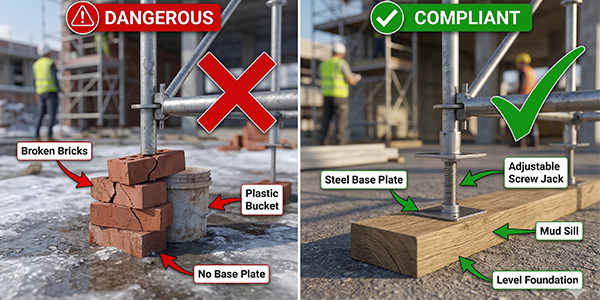
El uso de materiales comunes en una obra puede generar numerosos riesgos. Deben cumplirse todas las normativas relativas a las normas internacionales de construcción (como OSHA 1926.451 o EN 12811-1).
El papel de la placa base
Todas las patas de andamio deben contar con una placa base metálica del tamaño adecuado para soportar la carga total del poste vertical. Es un requisito casi universal en todos los códigos de seguridad que un andamio no se monte sin una placa base. El tubo hueco de la pata del andamio actúa como un cortador de galletas y tiende a cortar la madera o a hundirse en la tierra.
La necesidad de los diques de lodo
Un umbral de lodo es una viga de madera pesada (de al menos 2 pulgadas de espesor y 10 pulgadas de ancho) colocada debajo de la placa base.
- Distribución de carga:El umbral de lodo absorbe la presión de la placa base y la distribuye sobre una superficie mayor del terreno.
- Estabilidad:Sobre tierra o asfalto, los umbrales de lodo impiden que las placas base metálicas se "desplacen" o se muevan.
- Requisito: Los diques de contención deben ser continuos y estar nivelados. Deben tener la longitud suficiente para soportar al menos dos patas de andamio, de modo que la estructura se mueva (si es que se mueve) como una sola unidad, en lugar de que las patas individuales se hundan de forma independiente.
Gatos de tornillo ajustables
No se pueden usar ladrillos, restos de madera, etc., para nivelar un andamio en una pendiente. Para ello, deben utilizarse gatos de tornillo ajustables. Un gato de tornillo ajustable permite realizar ajustes de altura graduales en el andamio, a la vez que proporciona una rosca completa en la estructura. Las cargas sobre los gatos deben apoyarse y mantenerse directamente sobre la base y en posición vertical.
Factores ambientales y evaluación del sitio
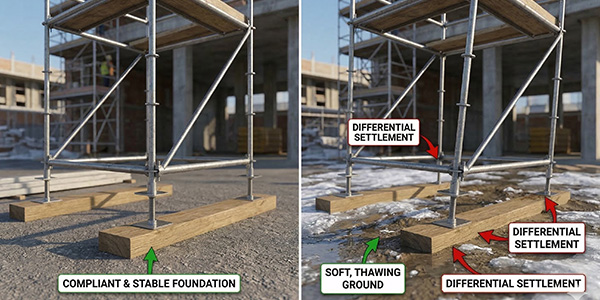
Más allá de los materiales físicos, el entorno también influye en la estabilidad.
- Gestión del agua:El agua estancada cerca de la base de un andamio puede erosionar el suelo bajo los diques de contención. Es fundamental garantizar un drenaje adecuado del terreno para evitar que los cimientos sean arrastrados por la lluvia.
- Servicios públicos subterráneos:No se deben instalar andamios sobre puntos débiles como tapas de alcantarilla, fosas sépticas o cámaras subterráneas sin refuerzo. El peso del andamio puede provocar el derrumbe de estas estructuras.
- Protección contra impactos: En zonas de mucho tránsito, los soportes de la base deben estar protegidos contra impactos accidentales de vehículos o maquinaria pesada, que podrían desplazar incluso una base correctamente apoyada.
Lista de verificación de cumplimiento para soporte estructural
Para garantizar la máxima calidad del trabajo, es necesario comprobar los siguientes elementos antes de comenzar cualquier labor en la base del andamio:
- Tipo de base:¿La superficie es capaz de soportar la carga prevista sin asentamiento? (Verifique la compactación del suelo).
- Placas base:¿Todos los soportes verticales están equipados con placas base metálicas homologadas de fábrica?
- Umbrales de lodo:¿Se utilizan umbrales de lodo de tamaño adecuado (por ejemplo, 2" x 10") en todas las superficies que no sean de hormigón o roca sólida?
- Arrasamiento:¿Se utilizan gatos de tornillo ajustables para nivelar en lugar de calzas improvisadas?
- Plomería:¿El andamio está vertical dentro de la tolerancia permitida (generalmente una relación de 1:360)?
- Obstáculos: ¿Se está utilizando algún material prohibido (ladrillos, bloques, palés) en algún punto de los cimientos?
Conclusión
En general, la estabilidad de los andamios es un requisito fundamental en la construcción. El uso de materiales inadecuados, como ladrillos, cubos o madera sobrante, en lugar de los materiales especificados, como placas base, soleras y gatos de tornillo, puede comprometer fácilmente la seguridad de toda la estructura. Las obras de construcción siempre deben realizarse de acuerdo con los principios de diseño estructural y deben utilizarse materiales y componentes de andamiaje adecuados.
La seguridad operativa y la integridad de su estructura están en riesgo si se utiliza un equipo de cimentación inadecuado. El incumplimiento de las normas sobre equipos de cimentación no es solo una cuestión administrativa; se trata de la integridad estructural y, potencialmente, de una cuestión de vida o muerte. Si se utiliza el equipo incorrecto, las consecuencias pueden ser catastróficas.
¿Busca equipos de andamiaje de alto rendimiento?
Asegúrese de que su próximo proyecto sea un éxito. Ya sea que necesite placas base estándar, soleras o gatos de tornillo, los tenemos todos. Todos nuestros productos cumplen o superan los estándares de seguridad de la industria.
[Solicitar un presupuesto técnico]
Preguntas frecuentes
¿Por qué están prohibidos los ladrillos y los bloques de hormigón como soportes para andamios?
- Los ladrillos y los bloques de hormigón se clasifican como "materiales frágiles". Si bien pueden soportar un peso considerable cuando forman parte de un muro sólido, no están diseñados para soportar cargas concentradas. carga puntual La presión ejercida por una pata del andamio, bajo tal fuerza, puede provocar que estos materiales se agrieten o se rompan instantáneamente, causando un colapso estructural repentino. Además, carecen de estabilidad lateral, lo que hace que el andamio sea propenso a volcarse.
¿Puedo usar restos de madera para nivelar un andamio si parece resistente?
- No. La madera de desecho a menudo contiene defectos ocultos como nudos, podredumbre interna o desviaciones de la veta que reducen significativamente su capacidad de carga. Además, la madera de desecho delgada puede partirse bajo la fuerte presión de una placa base. Solo umbrales de lodo diseñadosSe deben utilizar tablones de madera tratada a presión de 2x10 pulgadas, ya que están diseñados para distribuir el peso de manera uniforme sobre la superficie del suelo.



 en
en fr
fr es
es