Andamios de bambú Representan no solo una técnica de construcción, sino también una relación simbiótica entre la ingeniería moderna y la artesanía tradicional. Para contratistas de construcción, empresas de alquiler de andamios y distribuidores de materiales, obtener el control total de este método de construcción ofrece una oportunidad inigualable en cada sector: flexibilidad, valor económico y sostenibilidad.
La seguridad o integridad estructural de cualquier andamio de bambú depende completamente de: 1) la calidad del material y 2) la precisión de su construcción. La información proporcionada en esta guía ofrece un método ordenado, paso a paso, para construir un andamio de bambú, desde la selección del bambú en bruto hasta la inspección final de seguridad.
Introducción a los andamios de bambú
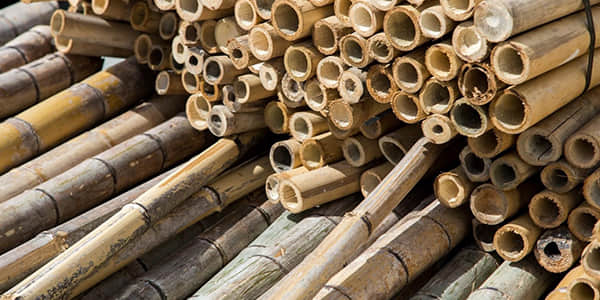
A nivel mundial, los andamios de bambú se están convirtiendo rápidamente en un método de construcción dominante en Asia, donde su resistencia y flexibilidad son especialmente valoradas en las zonas densamente pobladas de Europa y Asia, como Hong Kong. Gracias a su ligereza, los andamios de bambú se pueden montar en mucho menos tiempo que... Andamios de aceroSu flexibilidad permite su uso en edificios con diseños arquitectónicos irregulares. Los andamios de bambú difieren significativamente de los sistemas modulares de acero, que son completamente intercambiables y prefabricados. En cambio, los andamios de bambú requieren un constructor experto para ensamblar su sistema modular, por lo que su construcción se asemeja más a una artesanía que a un simple ensamblaje.
Cómo elegir el bambú adecuado
La base de una estructura segura comienza con la adquisición. No todos los postes de bambú son aptos para la construcción.
- Las especies importan: Busque Mao Jue para los principales soportes de carga (verticales) debido a su grosor (mín. 75 mm de diámetro). Utilice Kao Jue para largueros horizontales y arriostramientos gracias a su flexibilidad.
- Edad y madurezLo ideal es cosechar el bambú entre los 3 y los 5 años. Si es demasiado joven, se debilita; si es demasiado viejo, se vuelve quebradizo.
- Inspección visualAsegúrese de que el bambú no presente grietas extensas, plagas ni podredumbre. La piel debe estar verde o amarilla/canela al secarse, pero nunca gris (lo cual indica descomposición).
Herramientas y materiales esenciales
Construir andamios de bambú es un arte manual. A diferencia de los sistemas de acero que requieren maquinaria pesada, las herramientas para un andamio de bambú son sorprendentemente portátiles, pero específicas.
Herramientas necesarias
- Sierra de mano - Para cortar postes de bambú a su longitud específica en el lugar de trabajo.
- Cinta métrica Una herramienta importante para asegurar que los postes de bambú estén correctamente espaciados en la cuadrícula. Un espaciado adecuado garantiza que la carga de la estructura se distribuya uniformemente entre todos los postes.
- Martillo Se puede usar un martillo para golpear la caña de bambú y determinar su solidez (es decir, para comprobar si es sólida). También se puede usar un martillo para ajustar la estructura.
- Cincel - Se utiliza un cincel para partir el bambú al hacer ciertos tipos de uniones o calzas.
- Perforar Se utiliza un taladro para instalar pernos de anclaje en la fachada del edificio y crear puntos donde sujetar las cañas de bambú. El taladro no se utiliza para perforar el bambú directamente.
- Soga (Tiras de nailon) - El elemento más importante de los andamios modernos son las resistentes tiras de nailon de plástico que se utilizan para unir los postes de bambú y proporcionar un agarre extremadamente firme que se mantendrá en condiciones climáticas adversas.
Equipo de seguridad (EPP)
La seguridad es la prioridad para cualquier agencia gubernamental o empresa constructora. Los trabajadores deben estar equipados con:
- CascoLos cascos brindan protección a la cabeza contra la caída de escombros, así como contra impactos de la cabeza contra objetos (incluido el bambú).
- GuantesSe recomiendan guantes resistentes para atar el bambú debido a lo afilado y astillado que puede llegar a estar, por lo que se recomiendan guantes resistentes para proteger las manos de esos peligros.
- Gafas de seguridadLas gafas de seguridad también son muy importantes al cortar bambú y al perforar anclajes. Previenen lesiones oculares.
- Arnés de seguridad:Si un trabajador está trabajando a una altura de más de 6 pies, deberá usar un arnés de seguridad que esté sujeto a una línea de vida independiente o a un punto de anclaje sólido.
- Botas con punta de aceroLas botas con punta de acero brindan protección contra la caída de objetos pesados sobre los dedos de los pies y brindan tracción al trabajador en el edificio con estructura de bambú.
Preparación del lugar de trabajo
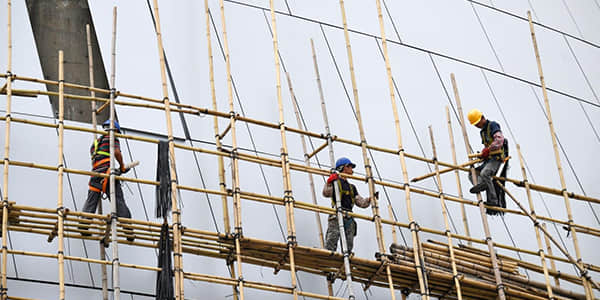
Antes de plantar el primer poste, es necesario preparar el sitio.
- Limpiar el área:Elimine todos los escombros y obstrucciones del área que rodea el edificio.
- Nivelación del suelo:Nivelar y compactar el terreno.
- Placas base:Use placas base para distribuir cargas desde vigas de bambú en pie cuando el suelo esté blando.
Creando la base
La base, o “falda”, marca la trayectoria de todo el andamio.
- DisposiciónMarque la ubicación de los soportes verticales. Están separados entre sí por una distancia de 600 a 750 mm, según la carga del andamio.
- Primer ascensor:La primera elevación de los postes debe realizarse con cuidado y asegurarse de que estén a plomo (perfectamente verticales), ya que esto determinará la estabilidad de toda la torre.
Montaje de soportes verticales
Los soportes verticales (estándares) actúan como la columna vertebral del andamio.
- Posicionamiento:Coloque los postes Mao Jue en las placas base.
- UniónDado que el bambú tiene una longitud limitada, las varillas se unen superponiéndolas (generalmente al menos 1,5 a 2 metros) y sujetándolas firmemente. Las uniones deben estar escalonadas para que no queden todas al mismo nivel, lo que crearía un punto débil.
Construcción del marco horizontal
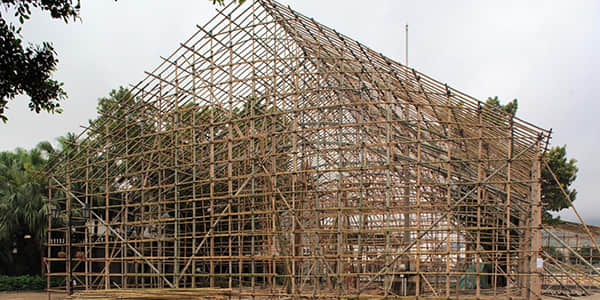
Una vez que las verticales están arriba, la cuadrícula debe bloquearse.
- Largueros y travesaños: Amarre los postes Kao Jue horizontales a los verticales. Estos deben estar nivelados para soportar las plataformas de trabajo.
- El nudo de amarreUn nudo correcto es vital. La tira de nailon actúa como abrazadera. Debe enrollarse varias veces y torcerse firmemente para evitar que el poste horizontal se deslice hacia abajo sobre el vertical.
- Arriostramiento diagonalPara evitar que el andamio se balancee o se derrumbe lateralmente, los tirantes diagonales forman una "X" a lo largo de la cara del andamio. Esta triangulación proporciona rigidez.
Controles e inspecciones de seguridad
Para los gerentes de proyecto, el trabajo no termina cuando la estructura está instalada. Se requiere una inspección rigurosa.
- Comprobar amarres:Asegúrese de que no haya tiras de nailon sueltas ni deshilachadas.
- Puntos de anclaje:Verifique que el andamio esté firmemente amarrado a la estructura del edificio (generalmente cada 3 metros).
- Pruebas de carga:Asegúrese de que las plataformas de trabajo estén completamente apoyadas y no se hundan.
- Comprobación del tiempo:Después de fuertes lluvias o vientos fuertes, es obligatoria una nueva inspección antes de que los trabajadores suban a la estructura.
Mantenimiento y reparaciones
El bambú es un material orgánico; reacciona con el medio ambiente.
- Control de humedad: Si el bambú permanece húmedo, se pudrirá, y si se seca por completo, puede quebrarse debido a su fragilidad. Por lo tanto, es necesario inspeccionar los postes periódicamente para determinar cuáles han perdido su integridad estructural (si es que hay alguno).
- Reapretar: Las correas de nailon se estiran ligeramente con el tiempo (pero en menor medida) o debido al calor. Revisar y reajustar los nudos regularmente requiere un mantenimiento regular.
- Reemplazo: Cualquier poste que esté agrietado o dañado debe reemplazarse en lugar de repararse para cumplir con los estándares de seguridad.
Conclusión
La construcción de andamios de bambú aumenta la productividad y la imaginación en la construcción, crea oportunidades para obtener resultados rápidos y asequibles en comparación con los métodos contemporáneos y promueve la sostenibilidad, un aspecto fundamental para gestionar las necesidades futuras. Las empresas constructoras pueden utilizar los métodos descritos en esta guía como una forma de aprovechar una técnica de construcción histórica que proporciona la máxima eficiencia y sienta las bases para la ejecución segura y eficaz de estructuras y proyectos complejos en todas las áreas de su organización.
¿Necesita asesoramiento o materiales profesionales?
[Contáctenos hoy]para obtener una cotización de materiales o para discutir las necesidades de andamios de su próximo proyecto.
Preguntas frecuentes
¿Por qué se siguen utilizando andamios de bambú si tenemos acero?
- Las razones principales son el costo, la velocidad y la adaptabilidad. El bambú es significativamente más económico de conseguir en Asia que el acero. Se puede erigir aproximadamente seis veces más rápido y no requiere maquinaria pesada para levantarlo. Y lo más importante, se puede cortar y adaptar para adaptarse a formas arquitectónicas complejas y no estándar (como balcones colgantes o fachadas curvas) donde las estructuras rígidas de acero serían difíciles o imposibles de instalar.
¿Se pueden utilizar andamios de bambú en climas lluviosos o húmedos?
- Sí, pero requiere un manejo cuidadoso. Si bien el bambú es naturalmente resistente al agua, la exposición prolongada a la humedad puede provocar su pudrición interna. Por el contrario, el calor extremo puede agrietarlo. La construcción moderna utiliza tiras de nailon en lugar de ratán natural para las ataduras, ya que el nailon no se afloja con los ciclos de humedad y sequía, lo que garantiza que los nudos se mantengan firmes independientemente del clima.
¿Qué tan alto se puede construir con andamios de bambú?
- En teoría, no hay límite de altura para los andamios de bambú, siempre que estén correctamente anclados y apuntalados. Se utilizan comúnmente en rascacielos de más de 60 plantas en ciudades como Hong Kong. Para alturas extremas, los ingenieros suelen diseñar andamios de doble capa e incorporar soportes de acero (putlogs) cada pocos pisos para redistribuir la carga hacia la estructura del edificio.



 en
en fr
fr es
es